New Puppy Gear Checklist
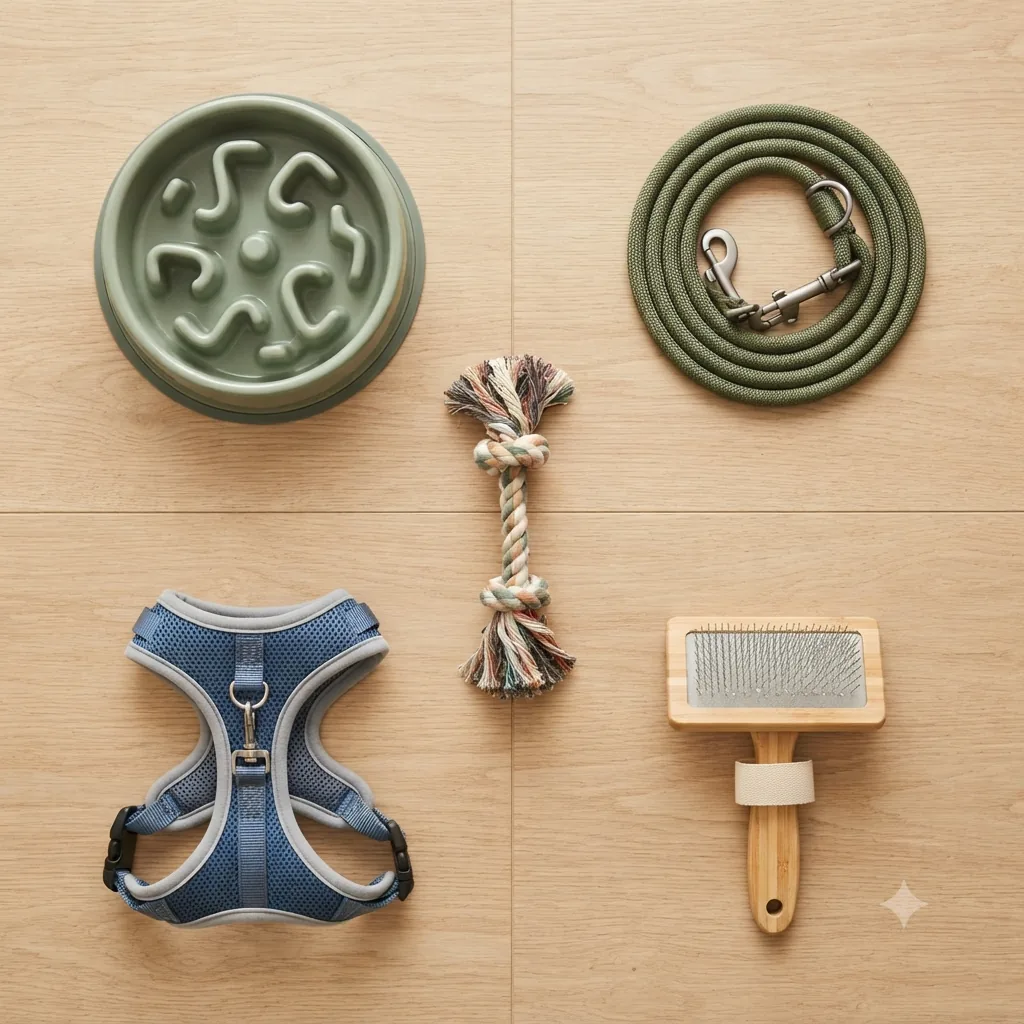
A new puppy needs 5 core gear classes: a wire crate with a divider, an adjustable harness, a 4-6ft leash, supervised chew toys, and shallow food and water bowls. In detail, those classes are: a wire crate with a divider panel (buy adult-projected size), an adjustable step-in or Y-front harness re-measured monthly, a standard 4-6ft leash, supervised chew toys matched to teething-stage jaw strength, and shallow food/water bowls. A GPS+cellular tracker is optional gear once a puppy starts exploring beyond the yard. We organize by budget band, not exact price — Amazon's own listing is the only reliable current price.
The gear classes
Research-based picks by gear class (how we evaluate), not hands-on lab tests. Live Amazon search links, no prices or ratings, an honest watch-out on each. Equipment guidance only — not veterinary advice.
Crate Wire Crate with Divider Panel
Buy adult-projected size (measured length + 2-4in, height + 2-4in); use the divider panel to shrink the space while your puppy is small
A divider panel means you buy one crate for the dog's whole life instead of upgrading three times.
Best for: Any puppy owner who wants to crate-train without repurchasing gear every few months
Watch out: An adult-size crate with no divider gives a puppy room to potty in one corner and sleep in the other — the divider is not optional, it's the point.
Search on AmazonNot deciding today? Add it to your cart over there — Amazon keeps it saved (and flags any price change) until you're ready.
Harness Step-In or Y-Front Harness (Adjustable)
Multi-point adjustable straps sized by current chest/neck girth, not projected adult size
Adjustable straps let you re-size every few weeks as a puppy grows, instead of buying a new harness monthly.
Best for: Puppies still growing into their adult frame
Watch out: Puppies outgrow fixed-size harnesses fast — re-measure chest girth monthly and re-adjust; a loose harness is a slip-out risk.
Search on AmazonNot deciding today? Add it to your cart over there — Amazon keeps it saved (and flags any price change) until you're ready.
Leash 4-6ft Standard Leash
Non-retractable, 4-6ft length, sized to the harness/collar's D-ring hardware
A fixed-length leash gives more control near traffic and other dogs than a retractable cord.
Best for: Basic leash walking and early training
Watch out: Retractable leashes are harder to control with an unpredictable puppy and the thin cord can cause rope burn — most trainers recommend starting with a standard fixed leash.
Search on AmazonNot deciding today? Add it to your cart over there — Amazon keeps it saved (and flags any price change) until you're ready.
Toys Puppy-Safe Chew Toys (Supervised)
Durability class rated for teething-stage jaw strength, not adult chewers
Matching toy durability class to a puppy's actual bite force avoids both destroyed toys and choking-hazard fragments.
Best for: Teething puppies who need supervised chew outlets
Watch out: No chew toy is indestructible under supervision-free use — always supervise chewing and replace anything with broken-off pieces immediately; ask your vet about teething-specific concerns.
Search on AmazonNot deciding today? Add it to your cart over there — Amazon keeps it saved (and flags any price change) until you're ready.
Tracker GPS + Cellular Tracker (Collar-Mount)
Cellular-subscription GPS unit rated for the puppy's projected adult collar size
A cellular GPS tracker works anywhere there's signal, unlike a Bluetooth-only tag limited to a few hundred feet.
Best for: Owners who want location coverage beyond the yard as the puppy starts exploring
Watch out: GPS+cellular trackers require an ongoing subscription and typically need charging every 2-3 days — factor in the recurring cost before buying.
Search on AmazonNot deciding today? Add it to your cart over there — Amazon keeps it saved (and flags any price change) until you're ready.
Bowls Puppy-Sized Food & Water Bowls
Shallow, non-tip bases sized to a small muzzle
A shallow, wide bowl is easier for a small puppy muzzle to reach the bottom of than a deep adult bowl.
Best for: Feeding-station setup for a new puppy
Watch out: This is equipment sizing only — portion amounts and diet are a question for your vet, not gear specs.
Search on AmazonNot deciding today? Add it to your cart over there — Amazon keeps it saved (and flags any price change) until you're ready.
Frequently Asked Questions
The core list: a properly sized wire crate with a divider panel, an adjustable step-in or Y-front harness, a standard 4-6ft leash, puppy-safe supervised chew toys, shallow food/water bowls, and optionally a GPS tracker as the puppy starts exploring beyond the yard.
No — buy the adult-projected size with a divider panel and slide the divider back as your puppy grows, rather than buying multiple crates.
Roughly monthly during active growth. Chest and neck girth change quickly, and a harness that fit two months ago can become unsafe.
Most trainers recommend starting with a standard fixed-length leash (4-6ft) for better control near traffic and other dogs; a thin retractable cord is harder to manage with an unpredictable puppy.
It's optional gear, not core — many owners wait until the puppy starts roaming beyond a fenced yard. Cellular GPS units add a subscription cost, so weigh that against how much unsupervised range your puppy actually gets.